

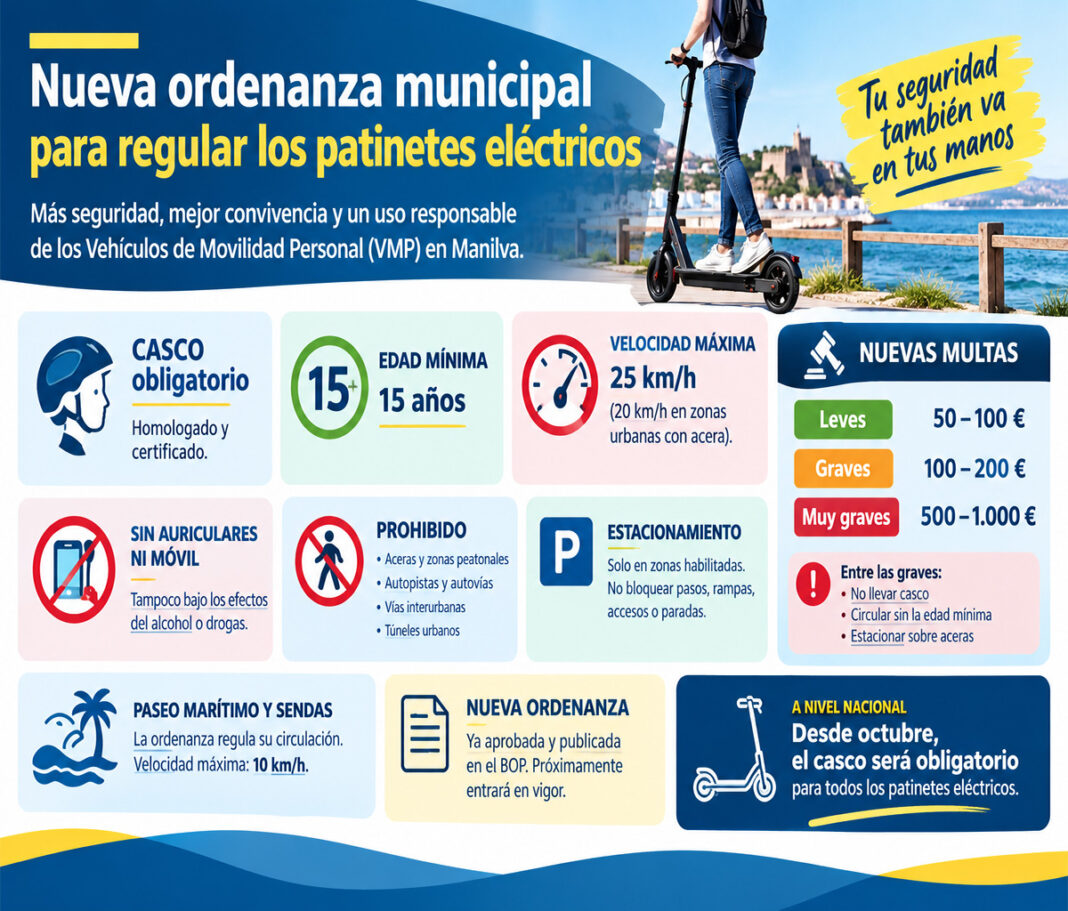

The municipal regulation has just been published in the BOP and sets out new rules for riding, parking and using Personal Mobility Vehicles (PMVs) in the municipality.
Manilva Town Hall now has a Bylaw Regulating the Circulation and Use of Personal Mobility Vehicles (PMVs). The full text was published on Monday, 14 September, in the Official Gazette of the Province of Málaga, after the initial approval agreed by the council meeting on 4 June received no objections during the public exhibition period.
The new regulation comes at a time when electric scooters have become a common means of transport in Manilva, and after action taken by the Local Police to remove from circulation vehicles that did not meet the requirements.
The bylaw aims to establish a specific framework for the circulation of these vehicles and to pay particular attention to coexistence with pedestrians, bicycles and the rest of the traffic, including the approximately eight kilometres of coastline, promenades, walkways and coastal path in the municipality.
Helmets compulsory and 15 as the minimum age
One of the main changes for users will be the obligation to wear an approved and certified protective helmet. The bylaw also sets 15 years as the minimum age to ride a PMV in Manilva.
Scooters will also be for single-person use, so they may not carry passengers, animals or objects that hinder safe riding.
Riding while using headphones, a mobile phone or other devices that reduce attention is also prohibited, as is riding under the influence of alcohol or drugs. Users will be required to take alcohol and drug tests when requested by officers.
Where they can be ridden
The bylaw sets a general maximum speed of 25 km/h, although on urban roads with a single surface shared by carriageway and pavement this is reduced to 20 km/h, and the Town Hall may set limits of up to 10 km/h by means of signage.
PMVs will be prohibited from riding on:
- Pavements and exclusively pedestrian areas.
- Through roads and inter-urban roads.
- Motorways and dual carriageways.
- Urban tunnels.
Where a cycle lane exists, its use will be compulsory as a general rule. On stretches where there is none, they must ride on the road, on the right.
In designated areas shared with pedestrians, priority must always be given to pedestrians.
Special attention to the promenade
On promenades, walkways, riverside paths and the coastal path, the bylaw sets a maximum speed of 10 km/h in areas where bicycles and PMVs are allowed. The Local Government Board may lower this limit on certain stretches and establish areas or times when PMVs are not allowed, as is already the case on the Sabinillas promenade.
Parking a scooter anywhere will also be prohibited
The new regulation establishes that PMVs must preferably be parked in designated and signposted spaces.
They may not block pedestrian crossings, ramps, dropped kerbs, building entrances, public transport stops or spaces reserved for people with reduced mobility. Chaining them to trees, traffic lights, benches and other street furniture is also prohibited.
Fines of up to 1,000 euros
The bylaw establishes three categories of offence:
- Minor: fines of 50 to 100 euros.
- Serious: fines of 100 to 200 euros.
- Very serious: fines of 500 to 1,000 euros.
Serious offences expressly include not wearing the compulsory helmet, riding below the minimum age, carrying passengers, parking on pavements or riding on certain prohibited roads.
Very serious offences include, among others, exceeding double the maximum speed, technically tampering with the vehicle to exceed its authorised characteristics, reckless riding, or riding with certain levels of alcohol or with drugs present.
In addition, where national regulations allow, officers may immobilise, remove and impound the vehicle.
And nationwide, helmets will also be compulsory from October
The entry into force of Manilva’s bylaw coincides almost exactly with an important change at national level. Royal Decree 518/2026, published in the BOE, amends the General Traffic Regulations and establishes new specific rules for PMVs.
From 1 October 2026, electric scooter riders will be required to wear an approved or certified protective helmet, properly fastened. In other words, it will not be solely a requirement of Manilva’s new bylaw, but an obligation established across the whole country.
The national reform also sets the minimum age for riding a PMV at 15 and establishes that users must use their arm to signal manoeuvres.
More changes arriving with the new national regulation
The reform also introduces other obligations and changes:
- Helmets compulsory for all PMV riders from 1 October 2026.
- 15 as the minimum age to ride these vehicles.
- PMVs must have lights switched on, although the specific obligation to use them during the day will apply from 1 October 2027.
- At night or when visibility is reduced, they must use lights or reflective elements visible from 150 metres.
- The ban on riding on pavements remains.
- Local authorities will continue to have the power to determine the specific roads and areas where they may be ridden.
- The new national regulation expressly considers PMV riders to be vulnerable road users.
In addition, this year a new national framework for the identification and registration of PMVs has come into being. Royal Decree 52/2026 establishes that, in order to be ridden, they must have the corresponding certificate of circulation, be entered in the National Vehicle Register and carry the corresponding identification.
As for insurance, national regulations have also established a civil liability requirement for so-called light personal vehicles, within the framework created by Law 5/2025.
Older scooters have until January 2027
Manilva’s bylaw itself includes a transitional provision for non-certified PMVs that were sold before 22 January 2024.
These vehicles can benefit from the national transitional regime and continue to be ridden until 22 January 2027, provided they meet the established conditions. After that date, vehicles that cannot meet the certification requirements will no longer be allowed on the road.
A regulation that is now final
What began as a public consultation and later as an initial approval has therefore now become a definitively approved municipal bylaw, published in full in the BOP of Málaga.
The regulation will come into force once the legal deadlines following its publication have been met.
The Town Hall thus faces a new stage in the regulation of electric scooters in Manilva, with compulsory helmets, a minimum age of 15, speed limits, restrictions on where they can be ridden, specific rules for the promenade, parking regulation and a system of fines that can reach 1,000 euros; now all that remains is to put it into effect.




