

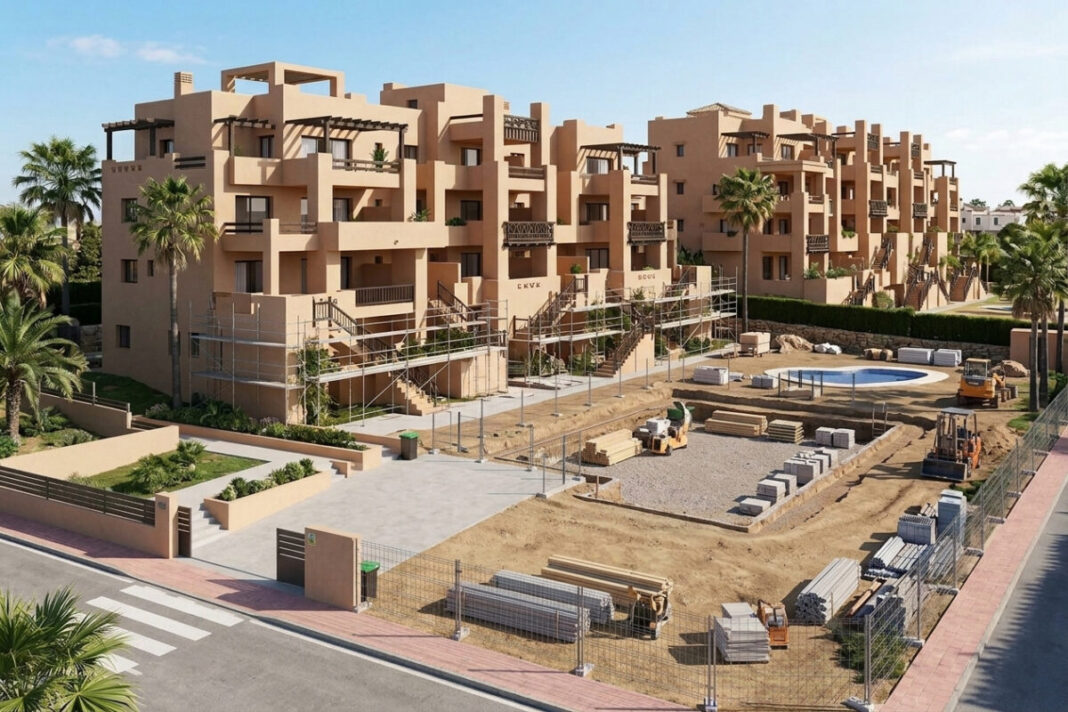

The Board of Manilva’s Urban Planning Department has approved the construction of 108 price-capped protected homes (VPPL) in the Coto Real area, an initiative that the governing team presents as a historic step after years without developments of this kind, but which the opposition considers insufficient and out of step with the real needs of the population.
A private development presented as a public solution
The mayor, Mario Jiménez, welcomed the approval of the project, saying it will “sort out the lives of 108 families”, and also highlighting the work of the Urban Planning department led by Juan Carlos Morejón.
However, one of the aspects that has drawn most criticism is that it is a private development at no cost to the public purse, which, in the opposition’s view, undermines the concept of protected housing as public policy.
Not VPO: homes for medium-to-high incomes
PSOE spokesperson Diego José Jiménez was particularly forceful in pointing out that these homes are not VPO (Vivienda de Protección Oficial, official protected housing) but VPPL (Vivienda Protegida de Precio Limitado, price-capped protected housing), a key difference that affects access for people on low incomes.
According to Diego José “Requiring an income of 4,200 euros a month to be able to apply for these homes shows they are not designed for the majority of residents”.
According to the opposition, this requirement excludes a large part of Manilva’s working population, at a time when wages have not grown at the same rate as housing prices.
Possible speculation: sale on the open market after 7 years
Another of the most controversial points is that these homes may be sold on the open market after seven years. For the PSOE, this opens the door to speculative deals: “Someone with money will be able to buy it and sell it at whatever price they like in seven years’ time”.
This point reinforces the criticism that the project could benefit investors more than residents who genuinely struggle to access housing.
Expectations versus reality
The announcement comes after great expectation around the construction of protected housing in the municipality; however, both the PSOE and the PP agree that the approved model does not match what is traditionally understood as accessible public housing.
For the Partido Popular, José Manuel Fernández also warns that the financial requirements, «around seven times the IPREM», will make access difficult for middle-income families, while the final price will be only slightly below that of the open market.
The governing team’s defence
For its part, the governing team maintains that this is a viable solution within the current legal framework and that it will put homes priced below 200,000 euros on the market.
The Urban Planning councillor insists that action has been taken “in record time” and that this project is part of a broader strategy that will include future developments, also for rent.
A first step… but far from solving the problem
Even among those who support the initiative, it is acknowledged that this is not a definitive solution. The problem of access to housing in Manilva, with rents exceeding 1,000 euros a month, remains structural.




