

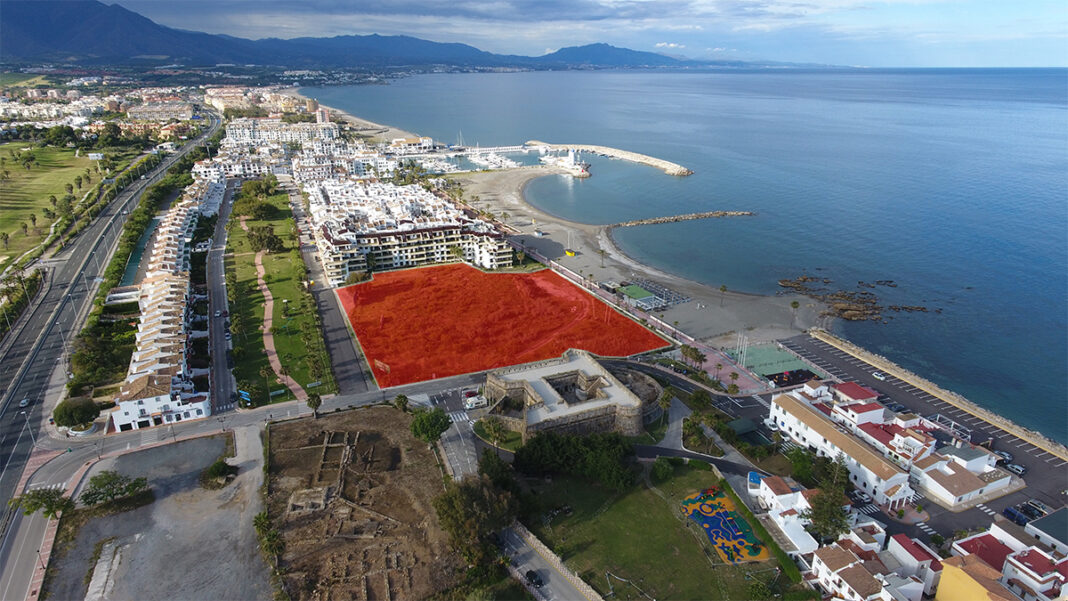

Manilva Town Hall will be responsible for managing the future Archaeological Museum, which will be created once the private plot near the Castillo de la Duquesa is developed, and which the owning company has put up for auction.
According to the mayor of Manilva, Mario Jiménez, in recent years the Andalusian regional government’s culture department (Junta de Andalucía) has been persuaded to authorise the development of this highly valuable plot on the seafront, always maintaining full conservation of the heritage, with the guarantee and protection for the site that the involvement of the culture department in the development of this project provides.
Thus, the building licence granted at the time, to which the owner was entitled, was conditional on obtaining a favourable report from the culture department of the Junta de Andalucía, the body that has established how this future property development must proceed in order to showcase the archaeological remains, with which an open-air Archaeological Museum will finally be created, fully public and open to visitors, and which must be handed over to Manilva Town Hall.
The developer of the residential project will have to set up this facility by building the future development on a special foundation, providing the area with large spans of up to 12 metres and heights ranging between 3.5 and 4 metres, which will allow the whole site to be used as a museum.
This archaeological site has been described by the culture department itself as a Roman villa a mare, which includes a large octagonal-plan building, among which a market area with tabernae can be clearly seen, a salted-fish factory zone, which included a series of vats for garum and other rooms, as well as a residential area, baths and a necropolis.
The remains date from between the 1st and 5th centuries AD, although with peak activity between the 1st and 2nd centuries of that same era.
The mayor wished to stress that the Town Hall is working to have the adjoining plot, which is municipally owned, made the subject of work to allow this future Archaeological Museum to be extended.
In addition, the current owner of the private plot happens to be the company Ros y Falcón, well known locally for having developed several buildings around the Puerto de la Duquesa and in the El Hacho area. This company entered insolvency proceedings, within which the sale of this private plot has been set as an asset, and it is now going to public auction.
The sale will also bring substantial income for Manilva Town Hall. In this regard, it should be noted that Ros y Falcón is the Town Hall’s main debtor and, in this specific case, the municipal coffers will receive more than 1.1 million euros in IBI (property tax) and municipal capital gains tax once the sale of the property is completed.
For the governing team, Jiménez explains, «the conservation of the archaeological site and of the cultural assets found throughout the municipality is very important, as shown by having achieved in this term of office that the necessary report from the Junta de Andalucía requires the protection of that whole area, which can be enjoyed by the people of Manilva and by visitors, as well as being of interest to our schoolchildren and to the whole region. Culture is a growing value in every sense and for Manilva Town Hall it is a very important commitment.»




