

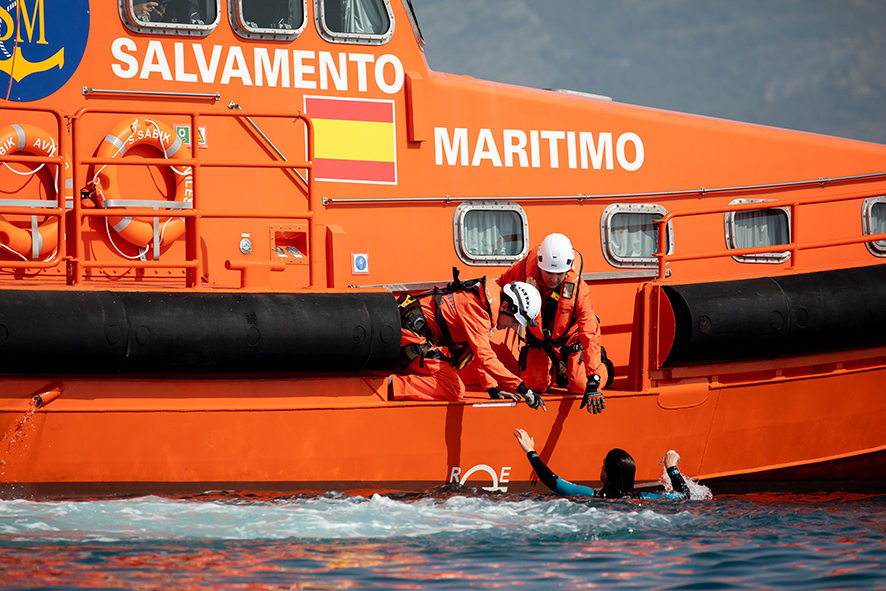

The Guardia Civil and Maritime Rescue (Salvamento Marítimo) coordinated a night-time operation to locate the three people on board, who were more than a mile from the coast, were not wearing life jackets, and one of whom could not swim.
Three people were rescued on Monday night in the Punta Chullera area after the paddle board they were on was swept out to sea by the westerly wind (poniente).
The alert was received at around 21:07, when the 112 emergency service notified the Maritime Rescue Coordination Centre in Tarifa that three people were in difficulty off Punta Chullera. According to the information provided during the operation, the board was carrying two men and a woman, none of whom was wearing a life jacket, and the woman could not swim.
The situation was made especially difficult by the late hour and the gradual loss of visibility. A Guardia Civil patrol went to the area and, from the shore, managed to spot the board through binoculars. The officers estimated its position at more than a mile from the coast, to the south-west.
A situation made worse by nightfall
Given the distance and the impossibility of returning by their own means, Maritime Rescue was alerted and mobilised the vessel Salvamar Gadir and the helicopter Helimer 222.
When the vessel reached the area, at around 21:50, it was already dark and the board was no longer visible from land. The references provided by the Guardia Civil officers proved essential in allowing the rescue teams to continue the search.
Finally, at around 21:53-21:55, the rescuers located the board and took its three occupants on board. They were taken to Estepona in good condition. The helicopter, which had also been mobilised, arrived in the area during the final phase of the operation and returned to its base after confirming that the people from the board were already safe.
The intervention prevented what began as an adventure outing at sea from turning into an emergency with far more serious consequences.
Paddle surfing is not without danger in this area
Once again the alarm has been raised, with calls for extreme caution when paddle surfing off the Manilva coast, especially among people new to the sport who are unfamiliar with the wind and tide changes, which can shift from one moment to the next.
Although the sea may look calm from the shore, conditions can change quickly. In an area such as the Manilva coast, where wind, swell and the currents of the Strait come together, a change in wind direction or strength can carry a person on a board away from the coast much faster than they might imagine.
The poniente can be a particular risk factor for those who do not know how the sea behaves in this area. An inexperienced person may try to paddle straight back to shore and find that, despite their efforts, they continue to drift away because of the wind and current.
The difficulty increases further when night falls. A paddle board has very low visibility from a rescue vessel and, once the coast is out of sight, it can be hard to work out your position and the right direction in which to return.
Training and prevention, key before going into the sea
The Punta Chullera incident also carries an important message about prevention: being able to stand on a board is not enough to paddle surf safely.
Those starting out in this activity should first find out about the weather and sea conditions, know how to read the wind and currents in the area and, above all, avoid moving away from the coast if they do not have sufficient experience.
The Paddle Surf Workshop, organised with the local club together with the youth department, began only yesterday, with the aim of teaching young people the ins and outs of this enjoyable sport and its risks so that they can practise it safely.
Wearing a life jacket or buoyancy aid, carrying a suitable means of communication and avoiding going out to sea when conditions are not appropriate are basic measures that can make all the difference in an emergency.
It is also advisable to tell someone on land about your planned outing, check the weather forecast before entering the water and not to carry out this type of activity near dusk if you do not have the necessary experience and equipment.
In this case, the swift intervention of the Guardia Civil and the coordination with Maritime Rescue made it possible to find the three people before the situation became even more difficult.
A paddle board can give a false sense of security, but off the coast the sea can change within minutes. Knowing the area, respecting the conditions and having a minimum of training before moving away from the shore is no minor matter: it can be the difference between enjoying the sea and needing a rescue.




