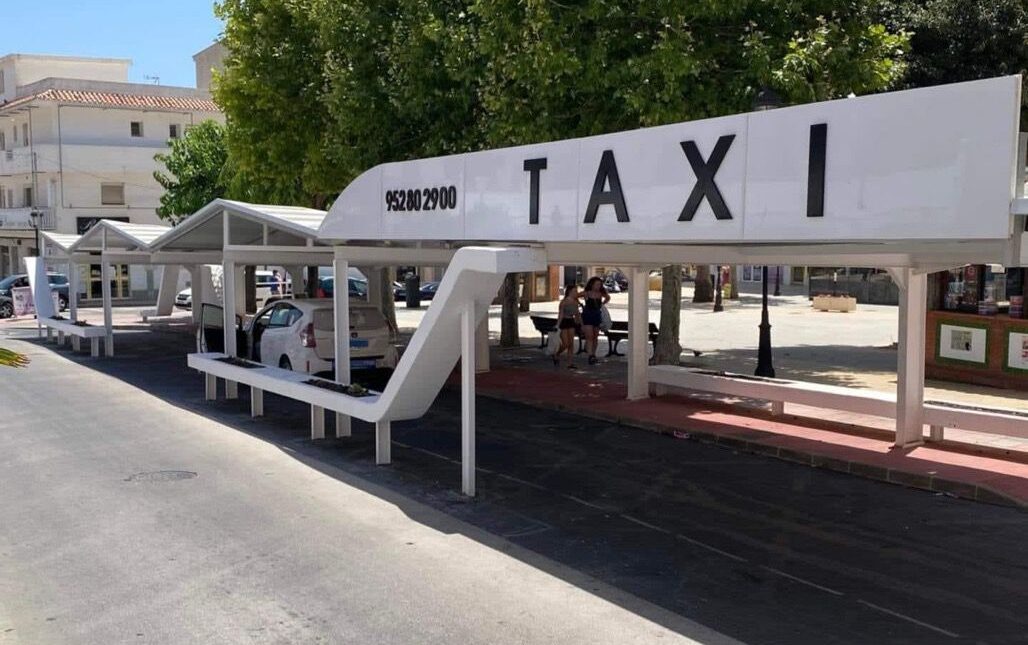

A post by the PP, after meeting representatives of the Taxi Association, has prompted a public response from one of the sector’s professionals, who defends the need to expand the service and questions the working situation of some of the workers.
The possibility of granting three new municipal licences has generated opposing positions that do not appear to be limited to the Town Hall and the opposition, but also reflect different views among those who work within the sector.
The controversy began after the Partido Popular of Manilva published a statement this morning saying it had held a meeting with representatives of the Taxi Association, who are said to have expressed their concern at the governing team’s intention to increase the number of licences by 20%.
According to the PP, the professionals with whom its spokesperson met consider that the addition of three new taxis could seriously harm the finances of the families who currently make their living from this activity. The party also recalls that the Junta de Andalucía rejected an earlier municipal request to create another three licences in December 2025, a decision that the Town Hall is said to have appealed in the courts.
The PP also questions whether this expansion can be justified by the needs of certain social associations, claiming that the taxi drivers they have spoken to told them that these organisations had not used their services in the last two years.
As an alternative, the PP says the professionals would be willing to consider the possibility of introducing temporary licences to reinforce the service in periods of higher demand. According to the party, this proposal would not be accepted by the mayor.
A taxi driver’s response: «We have a shortage of licences»
However, the PP’s post was quickly answered from within the sector itself. One of Manilva’s taxi professionals has publicly offered a very different account of the situation, questioning whether the position conveyed by the Association represents the reality of all the workers.
In his message, addressed to users of the service, he states that there are currently 15 taxis, of which only seven are said to be worked directly by their owners, while the remaining eight operate with salaried drivers.
The taxi driver places particular emphasis on the conditions of these workers, stating that, although their full working weeks are set at 35 hours, some are said to work between 70 and 80 hours in order to meet demand.
«We work 365 days a year with no break, because demand means we cannot rest», he says in his post, in which he argues that the municipality needs more licences to guarantee adequate service.
The professional also directs harsh criticism at licence holders who, according to his account, do not work directly in the service and keep their business running through salaried staff. He considers that the people being defended are holders who take no part in the day-to-day running of the taxi, while their employees endure very long working days.
In this regard, he questions why the possible expansion of licences is being blamed for economic harm to the sector without taking into account, in his view, the difficulties faced by those who actually provide the service.
Two views on the future of taxis in Manilva
The two posts deserve to be examined beyond the political confrontation.
On one side are those who believe that increasing the number of licences could jeopardise the profitability of current holders and, with it, the financial stability of their families. On the other, there are professionals who maintain that the current number of taxis is insufficient to meet the municipality’s needs and that the lack of vehicles ends up affecting both workers and users.
An important question also remains: to what extent does the position of the Taxi Association’s representatives match that of all the professionals who work in the service every day?
What does seem clear is that the discussion about the three new licences reopens an internal debate that goes beyond how many taxis Manilva should have: it also raises how the service is currently organised, what conditions its workers have and what transport model a municipality like Manilva needs in order to serve its residents and visitors, especially in high season, without harming the sector when demand falls during the rest of the year.