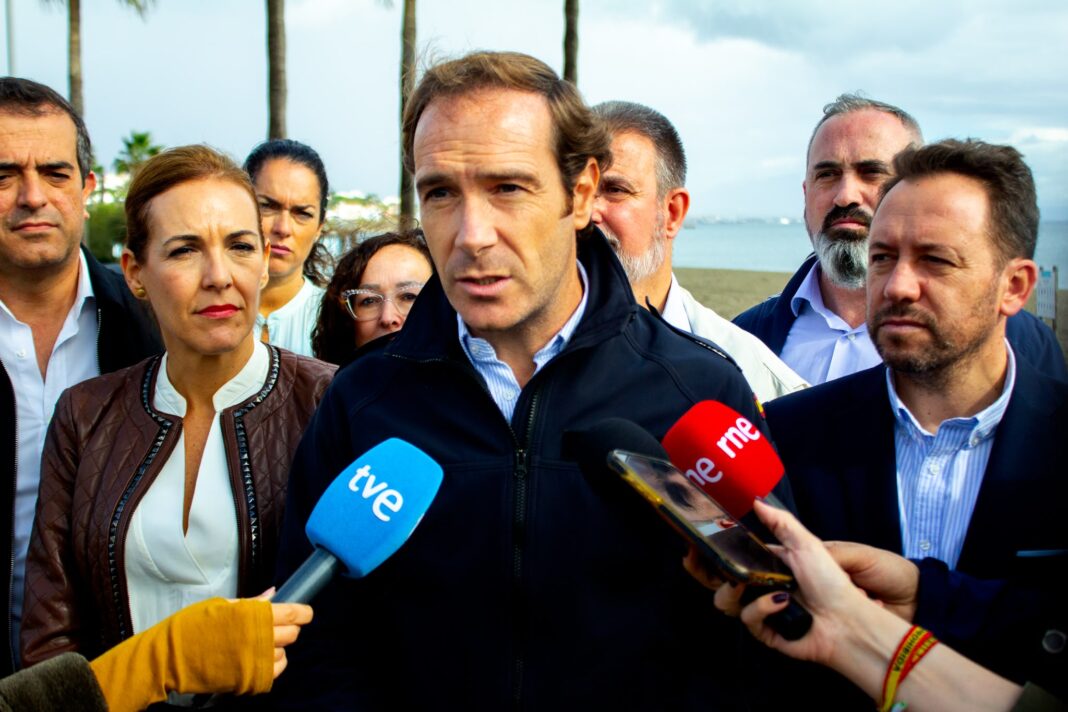

Javier Cortés began his address by denouncing the transfer of around 300 immigrants to various reception centres in the province of Málaga, a situation he linked to the migration management of the Socialist government.
The Vox spokesman criticised what he considers “an insufficient border policy” and called for the expulsion of those who are in Spain illegally, through legally established procedures.
“There is no room for a single further immigrant in Spain”, said Cortés, who also defended the need to promote “a process of remigration”.
He also argued that population growth, without sufficient planning of public services and housing supply, is aggravating problems such as access to housing, pressure on healthcare and demand for social benefits.
“Our young people have no access to housing. Housing has become brutally more expensive, both to rent and to buy”, he said.
In this regard, Cortés defended a review of migration policy and of the criteria for access to certain public aid, insisting that the authorities must guarantee the sustainability of services and attend to the needs of Spaniards.
https://youtu.be/kwu3gkXi4RY
Spread of drug trafficking along the Costa del Sol
During his appearance in Manilva, the Vox spokesman focused his criticism on the activity of drug trafficking organisations on the Andalusian coast, particularly on the Costa del Sol and the Campo de Gibraltar.
The spokesman denounced the presence of narco-boats off the coast of Málaga and warned that these activities are spreading to other Andalusian provinces, including the routes used by criminal organisations along the River Guadalquivir.
“The Costa del Sol has become the epicentre of organised crime”, he said, warning of the consequences that the presence of these networks has for safety and coexistence in coastal towns.
The MP expressed his concern about the images recorded during the summer at various points along the coast and about the activity of people who allegedly collaborate with drug traffickers by acting as lookouts and warning of police movements.
For Cortés, the institutional response “must be aimed both at those who transport and distribute the drug and at the economic and organisational structures that sustain the criminal business”.
Vox demands the restoration of OCON-Sur and a stronger fight against the mafias
The Vox spokesman held the Interior Minister, Fernando Grande-Marlaska, politically responsible for the reorganisation of the former OCON-Sur, the specialised Guardia Civil unit dedicated to combating drug trafficking in Andalusia.
Cortés defended the work carried out by this unit, highlighting in particular its ability to investigate criminal networks, pursue drug trafficking and trace the financial profits made by the organisations, and asserting that “OCON-Sur will be restored when VOX comes to the Government of Spain”.
The politician insisted that “the fight against drug trafficking cannot be limited to the seizure of boats or narcotic substances, but must also reach those in charge of the organisations and their sources of funding”.
In this regard, he called for a police and judicial strategy capable of acting against the whole structure of organised crime.
More resources for the Guardia Civil and the National Police and recognition as a high-risk profession
Javier Cortés also echoed the demands of the Guardia Civil professional associations and the police unions, which have been calling for greater human, material and technical resources to combat drug trafficking.
“They have no human resources, they have no technical material resources and they have neither maritime nor land resources to tackle drug trafficking”, he said.
The spokesman argued that officers should have adequate boats, vehicles, equipment and sufficient resources to confront criminal organisations that use increasingly sophisticated means.
He also called for recognition of the high-risk profession for members of the State Security Forces and Corps, adding in this regard that “we will always stand alongside our State Security Forces and Corps”.
Cortés also proposed legal reforms to toughen the response to drug trafficking organisations and to review the treatment of minors involved in these activities, within the corresponding legal framework.
Reindustrialisation and employment to prevent young people from seeing drug trafficking as their only way out
Finally, Javier Cortés argued that “the response to drug trafficking must combine police and judicial action with economic policies capable of generating employment and opportunities in the most affected areas”.
The Vox spokesman warned that “the lack of job prospects can make it easier for criminal organisations to recruit young people, especially in areas where these networks have a long-standing presence”.
“We have to do everything possible to reindustrialise our land again, so that opportunities come, so that jobs come and so that wealth is generated”, he said.
In this context, Cortés referred to an agreement between the Partido Popular and Vox in Andalusia which, as he explained,” provides for earmarking 50 million euros this year to promote reindustrialisation”.
Cortés concluded by defending a comprehensive response that combines greater resources for the State Security Forces and Corps, measures against the mafias’ financial structures and an industrial policy capable of offering real alternatives to young Andalusians.