

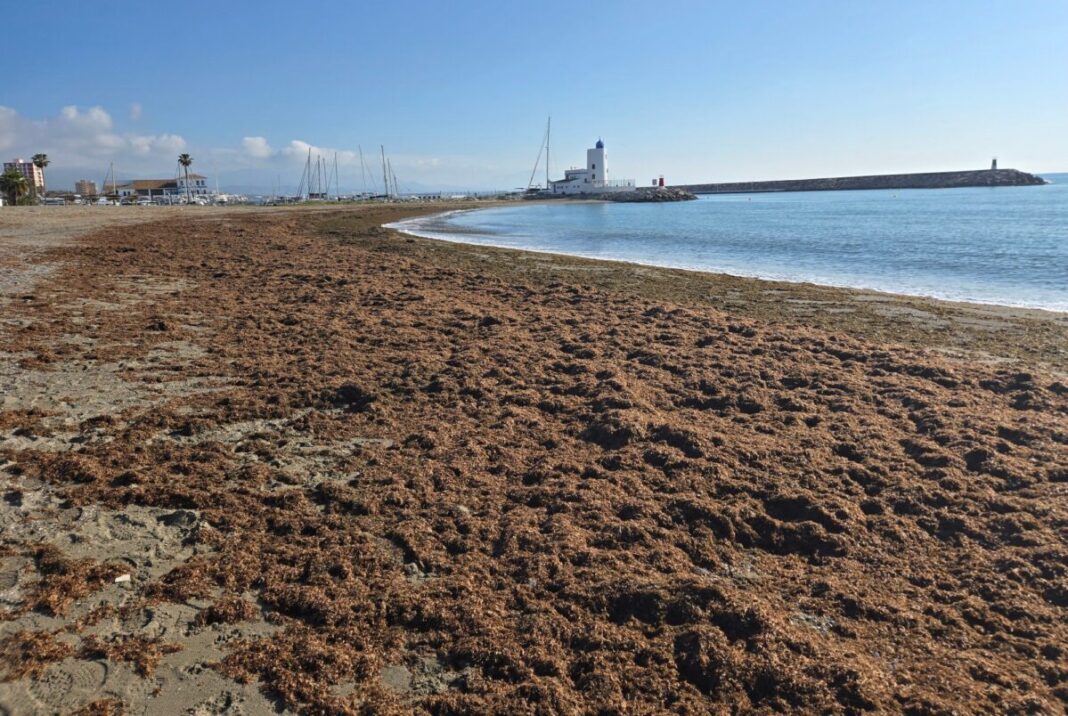

The Andalusian government will allow exemptions from the state landfill tax in response to an environmental problem that has already forced the removal of hundreds of tonnes along our coastline.
At the start of April the Town Hall removed more than 600 tonnes of algae from its beaches following the easterly storms, with Las Gaviotas particularly affected, and now the Junta de Andalucía has taken a step that will be important in easing the financial burden of removing it.
The Governing Council has agreed to recognise the massive arrival of washed-up Rugulopteryx okamurae, popularly known as Asian algae, as a situation of force majeure and extreme necessity. This decision will allow the exemption from the state tax on depositing waste in landfill, set at 30 euros per tonne, to be applied. Until now, this cost has fallen directly on coastal municipalities, with the Mancomunidad de Municipios de la Costa del Sol covering part of it.
A problem that directly affects Manilva
The measure comes at a particularly delicate time for towns on the western Málaga coast such as Manilva, where the municipal effort has been considerable in recent weeks. The Beaches department has had to step up work with heavy machinery and workers to restore normality to the coastline after episodes of massive accumulation, collecting a total of 600 tonnes of algae.
An uncontrolled invasion since 2016
The Asian algae, native to the Pacific, was first detected in 2016 in the area around the Strait of Gibraltar. Since then, its spread has been rapid and constant, extending across all of Andalusia’s coastal provinces, with particular pressure in Cádiz and the western Costa del Sol.
Experts warn that its growth capacity is «extraordinary», generating unprecedented biomass that displaces native species and alters marine ecosystems. In fact, it was included in the Spanish Catalogue of Invasive Alien Species in 2020 and classed as a species of concern for the European Union in 2022.
Economic, environmental and tourism impact
The consequences of this invasion are manifold. In tourism, the build-up of algae on beaches causes bad smells, health and hygiene problems and damage to the image of the coastline, directly affecting destinations such as Manilva.
At the same time, the fishing sector is also suffering its effects, as the biomass hampers catches and damages fishing gear, increasing costs and reducing profitability.
Furthermore, managing this waste is a major logistical and economic challenge. At present, the options for making use of the algae are very limited, so the only viable solution remains transporting it to landfill, with the associated cost.
Financial relief for town halls
The Junta’s decision aims to avoid a financial penalty that municipalities consider unfair, given the unpredictable and unavoidable nature of the phenomenon.
Town halls such as Manilva’s, which have already had to devote significant resources to cleaning the coastline, will now be able to carry out this work under less budgetary pressure.
The measure will remain in force for as long as the extraordinary circumstances that led to this declaration persist, in a scenario where, according to experts, it is not feasible in the short term to eradicate this species or fully restore the affected ecosystems.
A challenge on the eve of the summer season
Far from subsiding, the presence of the Asian algae continues to grow year after year, forcing the authorities to adapt to a reality that is already part of daily life on the Andalusian coast.
In Manilva, meanwhile, work continues to keep the beaches in optimum condition, right on the eve of the high season, with uncertainty over how long this unprecedented environmental problem will last.




