

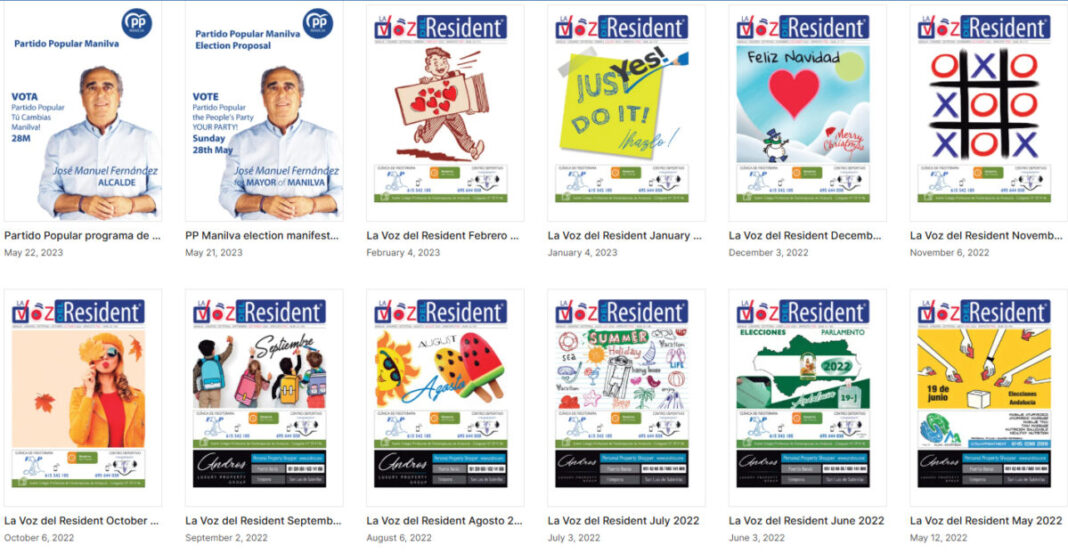

What remained of the local media outlet «La Voz del Resident» disappears. After passing the mark of 11,000 followers on Facebook, it has been renamed «José Manuel PPmanilva«, and since early July its posts have taken a turn: it has gone from publishing «Good mornings» with pretty photos of the municipality to acting as an opposition to the government, with photos of dirty streets or events related to the activities of Jose Manuel Fernandez of the Partido Popular.
Is this way of gaining followers ethical?
Using a themed social media profile, then changing its name and taking advantage of the reach and followers of the network to spread its own ideas, is not the first time this has happened in our town. The PSOE was the first to make it public on its social media, calling it a «deception», since if you are an active social media user in the town, you are very likely, from July onwards and without knowing it, a follower of «Jose Manuel PPmanilva» and will be seeing posts on your wall very different from those you were used to, with pretty photos of sunrises or, in the past, relevant news from the area.
The Resident and La Voz
To recap, a few years ago several local media outlets coexisted in the town, all working to keep local residents informed with news of incidents, events, interviews and curiosities. Thanks to all of them, anyone wanting to keep up with local affairs had a choice, and The Resident was even more focused on a foreign readership, with its monthly printed newspaper that reached beyond the digital audience.
In June 2020, the merger of the two gave rise to «La Voz del Resident», under the management of Dean Tyler Shelton and the editorship of Jose Manuel Fernández, who continued working together to extend their reach with news from Manilva, Casares and Estepona, maintaining their full-colour monthly print edition in Spanish and English.
As far as we can tell, the last printed issue of «La Voz del Resident» came out in February 2023. This suggests that, judging by the lists the PP drew up for the municipal elections held in May 2023, its leadership halted this project to devote as much time as possible to preparing the candidacy for mayor.
The outlet’s editor, Jose Manuel Fernandez, achieved his goal and became mayor of Manilva in the municipal elections held in 2023, as did the outlet’s manager, Dean Tyler, who became Second Deputy Mayor and completed his term before the vote of no confidence, holding the departments of Foreign Residents, Tourism, Housing Estates, Infrastructure and Works, Municipal Registration and Statistics, Social Affairs and Seniors, Equality and Diversity, Trade and Consumer Affairs.
Facebook in discreet mode
Once Fernandez became mayor, the Facebook account of «La Voz del Resident» went into a «discreet mode». It was not abandoned, and posts with pleasant photos of the municipality were published almost daily. On 18 May 2025 it was renamed «Manilva Noticias», a step prior to the new name change made on 17 July to «Jose Manuel PPmanilva», at which point its posts took a turn towards an aggressively oppositional line against the government that had made him lose the mayoralty through a vote of no confidence by his own coalition partners.
Politicians who measure their relevance by Facebook «likes»
In the age of social media, politics seems to have become a competition of virtual popularity, to the point of obsession. Increasingly, some politicians confuse the real impact of their work with the number of followers they accumulate on their Facebook accounts or the «likes» on their posts.
Instead of concentrating on proposals, results or substantive debates, many leaders devote time and resources to boosting posts, replying to strategic comments or celebrating each new «like» as if it were a vote won. The logic is simple: more followers equals more relevance. But is that really so?
Communication experts warn that this trend is dangerous. Social media can amplify a message, but they do not necessarily reflect the quality of a administration or the real interest of the public. In fact, there are quite a few cases of accounts inflated with fake followers or with interactions that have little to do with local politics.
Meanwhile, we can all see how politicians seem obsessed with reels, stories and absurd posts, trying to measure their influence in numbers of «likes» rather than in tangible results, such as a new secondary school, a new car park, or simple everyday improvements, creating a dynamic that leaves the impression that governing matters less than being «liked».




