

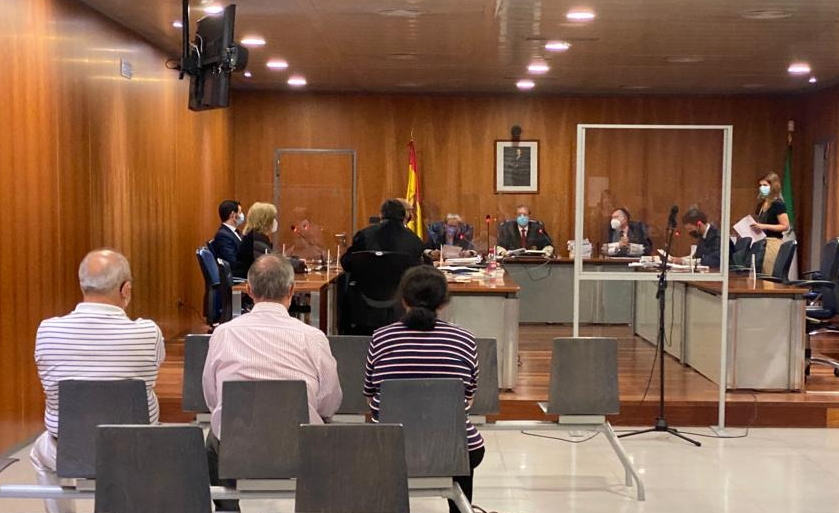

The Supreme Court has reduced to six years the disqualification from public employment or office imposed on the former mayor of Manilva (Málaga) Antonia Muñoz for the offence of administrative prevarication over irregularities in the hiring of municipal staff; specifically 749 contracts «without any procedure whatsoever» between 2007, when she took office as mayor, and 2013, the year in which she left it.
This is set out in two rulings of the high court: one partially upholding the appeal lodged by the defence of the accused against the ruling of the Provincial Court of Málaga, which sentenced her to nine years of special disqualification from any public office or employment; and another setting the sentence at six years and four months.
The Provincial Court of Málaga found it proven that during Muñoz’s time as mayor for IU, two municipal companies were operating that “appeared to be independent”, namely the Fundación de Desarrollo de Manilva and the Sociedad Deportiva Municipal, but which in reality were in “communion” with the council.
“In the name of the council or using the foundation or the sports company, Ms Muñoz systematically hired Town Hall staff without following any legal procedure, without a selection process, without regard to the constitutional principles of equality, merit and ability, simply choosing in a personal manner those whom the mayor decided to hire”, the Provincial Court stated.
This method of hiring “was habitual, the exceptions being those cases in which the receipt of funds from outside the council was conditional on compliance with the law”, according to what the Málaga court considered established.
In 2008, the other defendant in this case, A.M.C., was hired as legal adviser to the Town Hall, “the contract likewise being made without any selection process, without regard to the principles of equality, merit or ability”, according to the ruling.
The court therefore found that this defendant, “knowing, given his status as a lawyer and his municipal experience, of the absence of procedure and the failure to comply with the law”, consented to this method of hiring, and he was convicted of the same offence of administrative prevarication and sentenced to 21 months of special disqualification from public office or employment.
Undue delays
The defendants’ lawyers appealed against this ruling to the Supreme Court, which has dismissed in full the appeal brought by the defendant, confirming the sentence originally imposed; while it has partially upheld two of the arguments made by the former mayor’s lawyer, in this case concerning the sentence imposed.
In this regard, the Supreme Court considers that the individualisation of the sentence carried out by the Málaga court was incorrect, and notes that the latter took into account the complexity of the proceedings, due in part to the volume of documentation, and also the length of the investigation in order to determine the mitigating circumstance of undue delays.
It therefore corrects the Provincial Court and states that account must be taken of the undue delays and the continuing nature of the offence, as well as “the number of staff hirings made unlawfully and the time, four years, during which Muñoz held the office of mayor and carried out such unlawful actions”, and so it sets the sentence at six years and four months.
The legal adviser continues to provide his services at the Town Hall
According to information obtained by this newsroom, the legal adviser accused in these proceedings, whose appeal has been dismissed in full, is currently still carrying out significant duties in the Town Hall’s urban planning management body, «GEUMA», with no official public appointment having been made following the departure of the previous urban planning manager, and so further changes within GEUMA itself cannot be ruled out in the near future, as it currently has no formally appointed manager.
“Outside of any procedure”
It rejects the remaining arguments, such as the existence of a lack of defence due to the division of the proceedings into three separate parts, the Supreme Court considering that this “did not alter their nature nor did it tacitly imply the dismissal of the proceedings. Nor did it entail the reversal of the proceedings”. It likewise rejects the claim regarding the alleged loss of impartiality of the court.
It also adds that the testimony given by the Town Hall’s secretary and comptroller supports the conclusion that the former mayor “acted outside of any procedure, a circumstance of which she was not only aware, but which was pointed out” to her by them, and that she was “fully aware of the arbitrary nature of the new hirings that she carried out outside of any procedure”.
“Her conduct undoubtedly constitutes a contradiction of the legal system of such magnitude that it could be recognised by anyone. This was not a mere illegality, which may be the result of a mistaken, erroneous or debatable interpretation, as so often happens in law, but rather the accused acted by de facto means to impose her will”, the Supreme Court stresses.
It also considers that this is “a clear abuse of power which violated the basic pillar of a state governed by the rule of law, namely the subjection of public authorities to the law”, in that she proceeded to “hire all the workers by hand-picking them, except for those who would be monitored by the autonomous community because they depended on its grants”.
A course of action that “caused a materially unjust outcome”. “There is no doubt that there is non-material damage consisting of the blow that citizens’ belief in the credibility of institutions will suffer, and in the trust that these should deserve, because from custodians of legality they become its first offenders, with devastating effects on the public”.




