

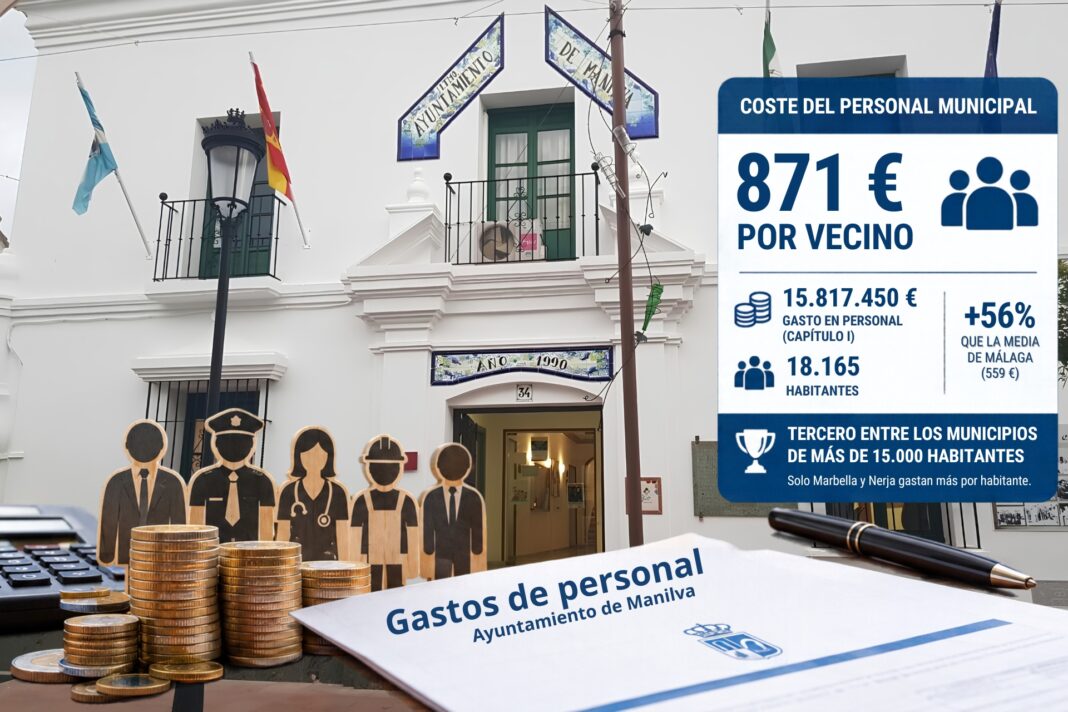

Manilva Town Hall spends 15.8 million euros on staff costs, 871 euros per resident. Among municipalities with more than 15,000 inhabitants, only Marbella and Nerja spend more per head.
Manilva has a municipal workforce that costs as much as that of a much larger municipality. According to the 2025 comparative spending data published by the Ministry of Finance, Manilva Town Hall allocates 15,817,450 euros to Chapter I, Staff Costs. With 18,165 inhabitants, that works out at 871 euros per resident, 56% more than the average for the province of Málaga, which stands at 559 euros.
If Manilva spent the same per head on staff as the provincial average, its budget under this chapter would be around 5.6 million euros lower.
Third among municipalities with more than 15,000 inhabitants
If only the 16 municipalities with more than 15,000 inhabitants for which data is available are compared, Manilva is the third highest spender on staff per inhabitant. Only Marbella (€1,161) and Nerja (€959) are ahead of it. It is well above Benalmádena (€618), Fuengirola (€576), Mijas (€534) and the provincial capital, Málaga (€422), which spends half as much per resident.
In absolute spending, Manilva ranks 13th in the province, ahead of municipalities with considerably larger populations, such as Coín, Torrox and Cártama.
| Municipality | Inhabitants | Staff spending | € per inhabitant | Civil servants, € per inhabitant |
|---|---|---|---|---|
| Marbella | 159,786 | €185,569,506 | €1,161.4 | €261.3 |
| Nerja | 22,132 | €21,214,447 | €958.5 | €181.8 |
| Manilva | 18,165 | €15,817,450 | €870.8 | €260.2 |
| Alhaurín el Grande | 27,552 | €15,940,385 | €578.6 | €117.9 |
| Torrox | 22,015 | €12,570,425 | €571.0 | €265.4 |
| Coín | 26,574 | €14,475,557 | €544.7 | €109.4 |
| Antequera | 41,849 | €18,796,744 | €449.2 | €111.2 |
| Estepona | 79,621 | €31,022,867 | €389.6 | €88.3 |
| Alhaurín de la Torre | 45,066 | €17,299,782 | €383.9 | €106.4 |
| Cártama | 29,333 | €9,002,504 | €306.9 | €154.9 |
More than double Estepona’s spending per resident
The comparison with neighbouring Estepona is the most striking. Estepona has more than four times the population of Manilva and spends 390 euros per inhabitant on staff. Manilva spends 2.2 times more per resident. With less than a quarter of the inhabitants, its staff spending is equivalent to half that of Estepona.
The situation is similar with Alhaurín de la Torre. It has 2.5 times the population of Manilva, but its staff spending is only 9% higher. Cártama, with 11,000 more residents, spends 9 million: Manilva spends 76% more than it does.
Civil servants, fourth place per inhabitant
A significant part of that spending goes on civil servant staff (Article 12), on which Manilva spends 4,725,773 euros, almost 30% of its staff spending. That is 260 euros per inhabitant, compared with a provincial average of around 193. In this item, Manilva is the fourth municipality of more than 15,000 inhabitants that spends most per resident, behind Benalmádena, Torrox and, by a few tenths, Marbella.
On civil servants alone, Manilva spends more than Antequera (41,849 inhabitants), Cártama (29,333 inhabitants) or Nerja (22,062), and practically the same as Alhaurín de la Torre (45,066 people), a municipality with 2.5 times its population. Per inhabitant, it spends almost three times as much as Estepona (88 euros).





El municipio de Manilva cuenta con una superficie de suelo urbano de 493,33 hectáreas y una capacidad residencial que, tras el desarrollo del planeamiento urbanístico, alcanza aproximadamente las 21.573 viviendas, con capacidad para albergar a 51.775 habitantes.
Esta realidad contrasta con los aproximadamente 18.165 habitantes censados, evidenciando una diferencia significativa entre la población oficial y la población efectiva a la que el municipio debe prestar servicios. Esta estimación se ve respaldada por indicadores objetivos, como los consumos de agua facilitados por Hidralia y los datos de recogida de residuos de Urbaser.
Por tanto, la planificación y evaluación de los servicios públicos municipales de Manilva no pueden basarse exclusivamente en la población censada, sino que deben considerar su capacidad residencial, su carácter turístico y la población real que utiliza sus infraestructuras y servicios. Cualquier valoración que ignore estos factores ofrecerá una visión incompleta de las necesidades y de la realidad del municipio.