

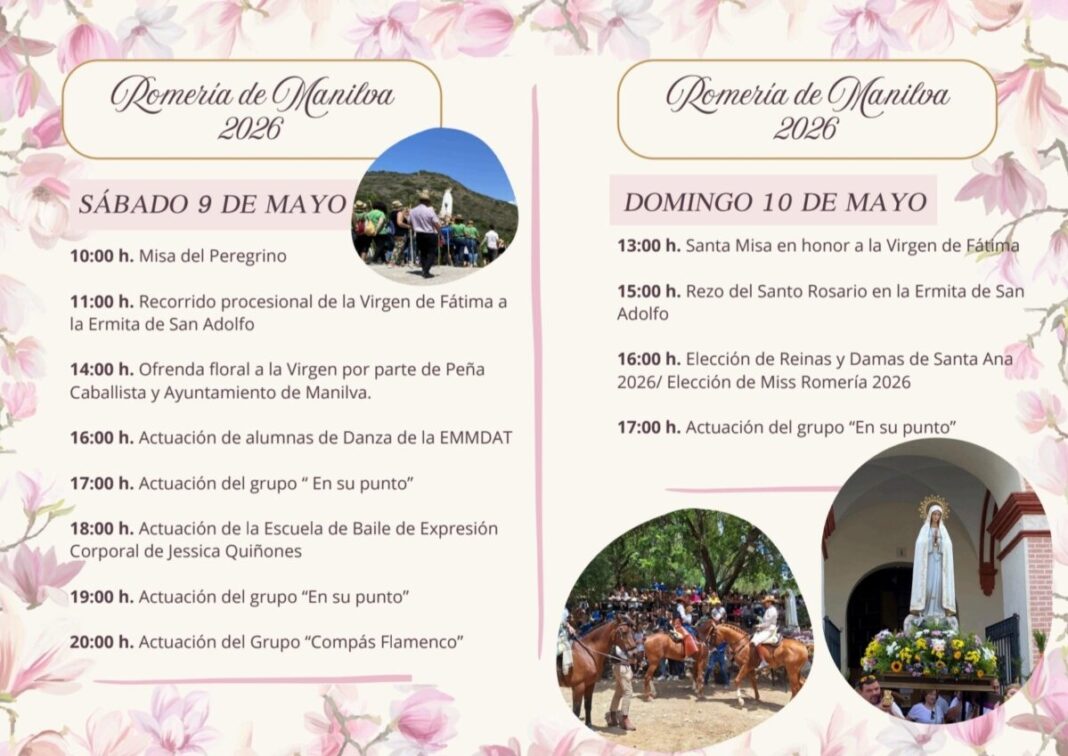

The Romería de Manilva (a traditional pilgrimage festival) 2026 now has a confirmed date and this year it is being held earlier than usual, on 9 and 10 May, when residents and visitors will be able to enjoy one of the municipality’s most deeply rooted traditions in the natural setting of the hermitage of San Adolfo, next to the Baños de la Hedionda.
A tradition with more than three decades of history
The Romería de Manilva, with more than 35 years of tradition, is held in honour of Our Lady of Fátima. It is a celebration that combines devotion, togetherness and a festive atmosphere in a unique natural setting, bringing together hundreds of people every year who accompany the Virgin as she is carried from the parish church of Santa Ana to the hermitage.
The event is organised by the Culture department, headed by Eva Galindo, together with the Cofradía de Nuestra Señora de los Dolores y Nuestro Padre Jesús Nazareno and the Parroquia Santa Ana.
🗓️ Updated programme of events for the Romería de Manilva 2026 (changed due to the rain forecast)
📅 Saturday 9 May
🕙 10:00 h. Pilgrim’s Mass (Santa Ana Church)
📍 Pabellón de Usos Múltiples (multipurpose pavilion):
🕛 12:00 h. Background music
🕑 14:00 h. Paella tasting
🕓 16:00 h. Dance performance by the EMMDAT
🕔 17:00 h. Election of the Queens and Ladies of Santa Ana 2026
➡️ Followed by a performance by the group “En Su Punto”
🕠 17:30 h. Afternoon snack of fried cakes (tortas fritas) with hot chocolate
🕡 18:30 h. Performance by Jessica Quiñones’ Escuela de Expresión Corporal
🕢 19:30 h. Second set by the group “En Su Punto”
🕣 20:30 h. Performance by the group “Compás Flamenco”
📅 Sunday 10 May
🕚 11:00 h. Romería Mass in honour of the Virgin of Fátima (Santa Ana Church), sung by the EMMDAT choir
Togetherness, music and tradition
Throughout the weekend, the romería becomes a place for people to come together, with plenty of music, dancing, food and a festive atmosphere.
On Sunday, after the romería Mass, those attending stay on at the site to enjoy a day in the countryside with friends and family, giving the Romería the social and participatory character of this celebration.




