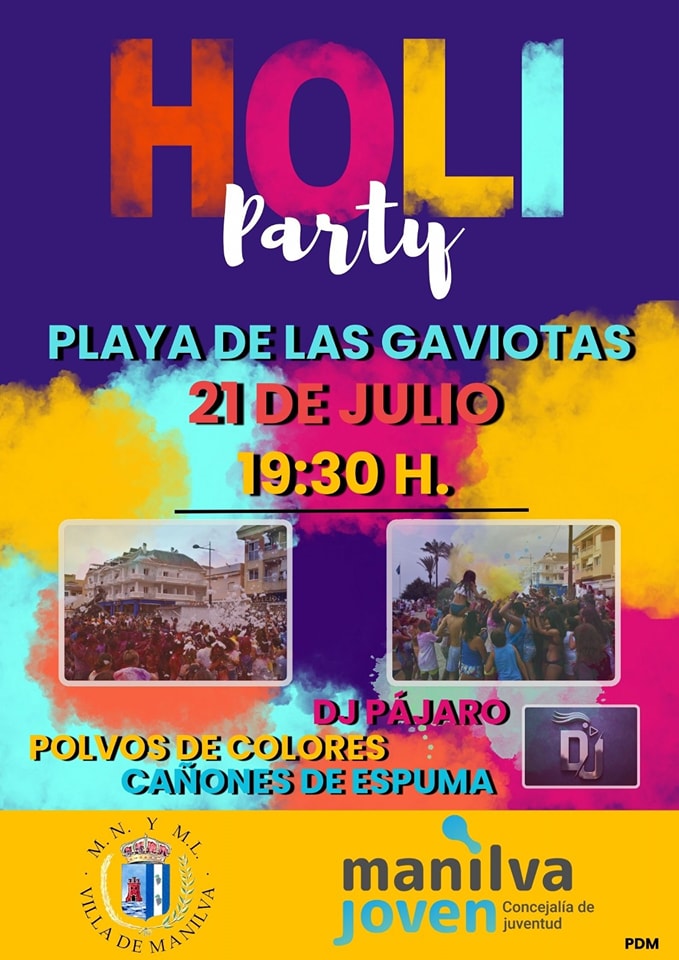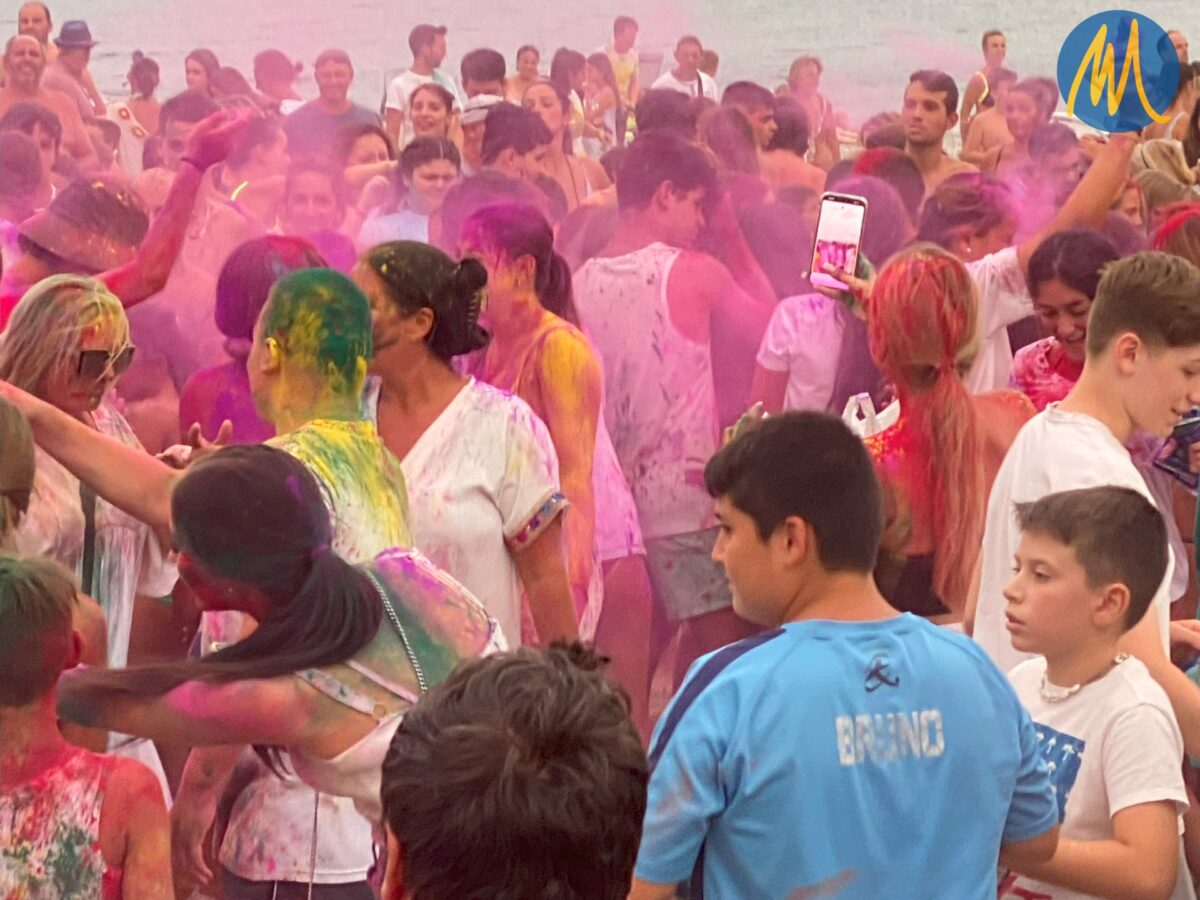
The Youth department of Manilva Town Hall is once again organising a celebration this Sunday 21 July at 19:30 on Playa de las Gaviotas: a Holi Party that promises fun for all ages, entertainment, music with a DJ, foam cannons and the traditional coloured powders of this distinctive festival of Hindu origin. But would you like to know more about where it comes from?
It is the Hindu festival par excellence, the festival where anything goes, in which «the differences between people and, at the same time, their unity» are celebrated. Holi is one of the most colourful festivals in the world. It is the Hindu festival par excellence and is celebrated in grand style in India, Nepal and in those places in the world with a large Indian community. But Holi is much more than a wild explosion of pigments forming a colourful cloud.
The festival of colours is held over two days between the end of February and the beginning of March, that is, shortly before the spring equinox. Specifically, the celebrations begin with the last full moon of the Hindu lunar month (Phalguna), but in Manilva we already know that the date matters least when it comes to celebrating any kind of party.
Among the typical foods and drinks prepared for the traditional festival in its place of origin, ‘bhang’ stands out: a brew made from marijuana leaves and milk which, according to tradition, is a gift from the god Shiva himself.
The main colours thrown around in abundance during Holi each have their meaning: red symbolises fertility; pink, love; blue, the colour of the god Krishna; yellow, that of the golden spice turmeric; and green represents spring.
To find the origin of the festival of colours, we must turn to Hindu mythology. Legend has it that Hiranyakashyapa, a king who believed himself a god and who decreed that only he could be worshipped, tried on several occasions to kill his son Prahlad, as the boy openly revered the god Vishnu. When he failed, the king sent for his sister Holika, a demoness immune to fire, who managed to get her nephew to sit with her on a bonfire. However, Prahlad emerged unharmed while his aunt burned to death. Immediately afterwards, Vishnu himself appeared as Narasimha, the man-lion, to kill Hiranyakashyapa, thus freeing the prince.
Holi commemorates this mythological story with numerous bonfires in which statues of Holika are burned, a symbol of evil that only the regenerating fire can destroy. This representation of the victory of good over evil is the first celebration of the festival and is called Holika Dahan or Chhoti Holi.
The following day is when the colossal battle of colours begins, known as Holi. There is also a mythological explanation for this. It is the immortal love story between the god Krishna and the mortal Radha, whose face the deity covered in colours to darken it, as her skin was lighter than his. Since then, all lovers paint their faces with the colours of Holi.
Music is also part of the Holi scene from first thing in the morning, when groups of drummers customarily gather to remind everyone of the start of the festive day, followed by dancing and singing for the rest of the day.
Source: El Mundo