

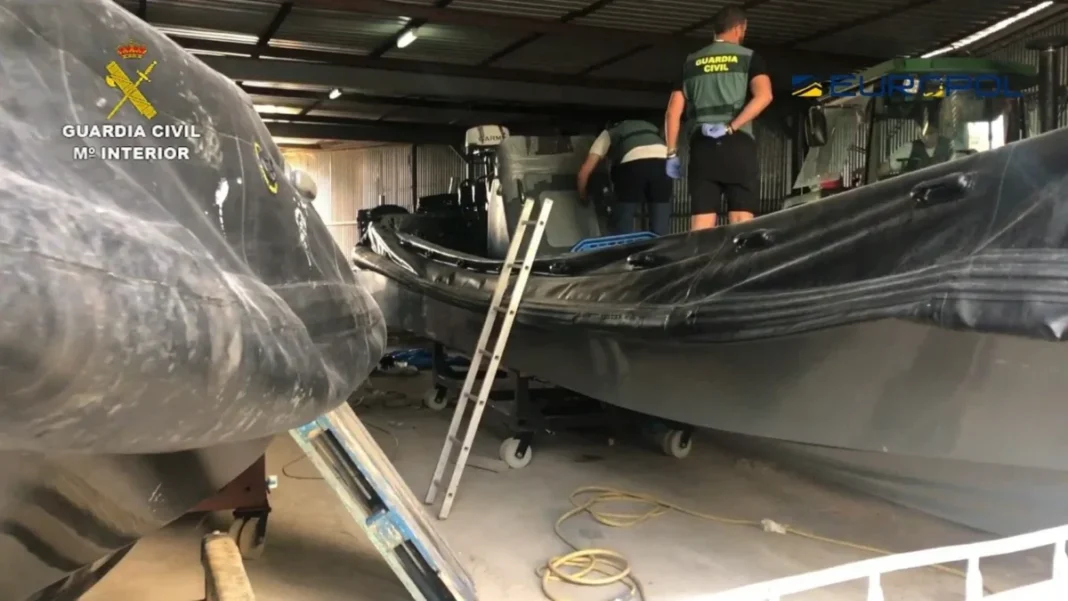

The lack of staff and resources is turning Manilva into a new base of operations for gangs fleeing the pressure in the Campo de Gibraltar. Increasing police pressure in the Campo de Gibraltar has pushed criminal networks towards other areas, and they have found in this town in Málaga province a place with less opposition in which to continue their criminal activity.
An «open bar» for drug traffickers
Antonio García, a Guardia Civil officer who has spent six months at the Manilva post and has six years’ experience in the Campo de Gibraltar, describes the situation as an “open bar for them”. He explains that the traffickers know the patrols’ movements perfectly. “They know where we are at all times. In the mornings, Monday to Friday, where is the patrol normally? At the court, with the detainees”.
This morning court routine, combined with the fact that there is only one patrol to cover a very large area, gives the traffickers a significant advantage. “Simply by keeping tabs on the patrol in the afternoons and at night, they know where they can unload without any problem”, laments Officer García.
The warning from his own colleagues before his transfer has become a harsh reality. “I had always wanted to request the Manilva post and those same colleagues told me not to because of the lack of staff. The first thing they tell you is: ‘You’re going to find yourself on your own here’. And sure enough, when I arrived, you realise that you really are on your own”, he says.
Lack of resources to fight crime
The shortage is not only of staff, but also of basic equipment. Antonio García gives a clear example of this defencelessness: the absence of thermal cameras. “They can’t send me to check on a boat on the beach at ten at night when I don’t even have a thermal camera. How am I supposed to see a boat without a thermal camera? It’s impossible”.
The spokesman for the Asociación Unificada de Guardias Civiles (AUGC), Rafael Sánchez, confirms this assessment. He explains that “organised crime and drug trafficking have been moving elsewhere for some time” in response to the greater pressure in the Campo de Gibraltar, which has been given “more resources and more personnel”. As a result, they are looking for outlets in other areas such as Huelva, Almería or the Málaga coast, where “it suits them very well, it’s very close to them”.
The Manilva team, made up of barely thirty officers, has to divide its time between office work, investigation and street patrols. This means that, as a rule, there is only one active patrol, which at times even has to cover the areas of nearby posts that are “just as badly off, or worse”.
Powerlessness and fear in the face of the drug gangs
This precarious situation creates a sense of powerlessness when confronting criminals. Rafael Sánchez says that officers are up against “narco-boats that are much faster than the Guardia Civil’s vessels” and that, by the time an official vessel arrives at the scene of a drop-off, the traffickers have already gone. On land, the situation is similar, with officers having to face traffickers carrying “weapons of war”, while the guardias civiles have none.
Another serious problem is the lack of suitable vehicles. Patrol cars are not adapted for “getting into rural areas, onto tracks and coastal areas with that kind of terrain”, which is where the traffickers escape with their cargo. “In some places it is impossible to get in with those vehicles”, says Sánchez.
As a result, officers work in fear while the traffickers “act with complete impunity”. “If there is a specialised unit, a helicopter and the best boats, you can fight back. But if one or two patrols on the ground have to take them on, in a vehicle that isn’t the most suitable and without weapons, it’s impossible”, Sánchez reflects. He concludes: “What you can’t do is demand that guardias civiles be heroes, that they go in with their chests bared and get themselves killed”.
In view of this serious situation, the AUGC has formally requested in writing, from both the Deputy Operational Director (DAO) of the Guardia Civil and the Government Sub-delegate in Málaga, Javier Salas, an urgent increase in staffing and material resources so that they can deal with the new reality of drug trafficking on the Costa del Sol.




