

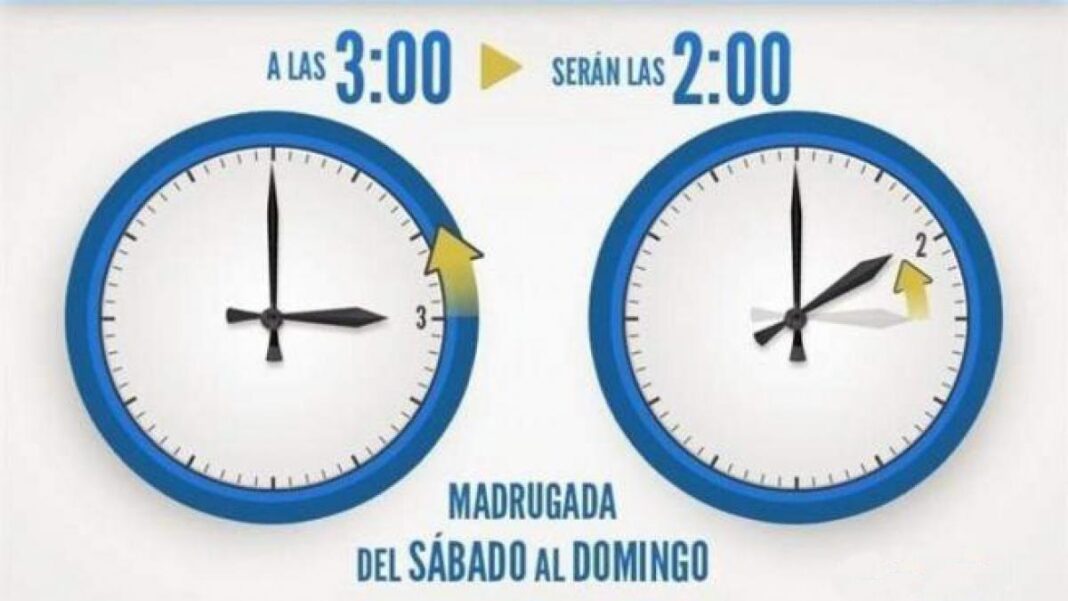

In the early hours of 28 to 29 October, the clocks change in Spain as the country moves to winter time. This time, 03:00 will become 02:00.
As we will see below, we know that this time adjustment will remain in place until October 2026. After that date, we still do not know whether this twice-yearly routine will become a thing of the past or whether we will have to keep asking ourselves whether that night we get an hour more or an hour less sleep.
Origin and history of the clock change
The American politician and scientist Benjamin Franklin (the inventor of the lightning rod, a founding father of the United States and the face of the American 100-dollar bill, among many other things) anonymously published an article in the Journal de Paris at the end of the 18th century, in which he explained how Parisians could save candles by adapting their habits to the hours of daylight.
Franklin was followed by the English builder William Willet, who at the beginning of the 20th century set out a series of savings measures involving a clock change in summer. He reached this conclusion because he was used to riding his horse before breakfast and noticed that Londoners slept for several hours while it was already light. His proposal, to avoid the change being too abrupt, was to adjust the clocks in weekly 20-minute steps.
Neither Franklin’s proposal nor Willet’s was implemented immediately, but they are considered the seed of what was to come. But when and where did the first clock change take place? It was in 1916 in the United States, and the reason was to save fuel at a time of shortages caused by the First World War.
Time zones in Spain
Before going into detail about the history and evolution of clock changes in Spain, it is worth looking at how time itself developed in our country.
At the beginning of the 20th century there were as many time zones in Spain as there were provinces, since time was set by the sun, a situation that led to differences of up to 42 minutes between one area and another. Radio news bulletins would have been quite entertaining had they existed at that time…
But what led to the unification of time?
The development of the railway, which needed to know the time in order to avoid collisions between trains, led to the need to unify timetables.
In July 1900, Queen María Cristina of Habsburg-Lorraine (regent after the death of Alfonso XII fifteen years earlier) put an end to the problem by signing a decree that unified time across the whole of Spain, including the Canary Islands (which would not move to one hour behind mainland Spain until 1922), following the Greenwich Meridian. Although, as we have said, the decree was signed in 1900, it did not come into force until 1 January 1901.
History of the clock change in Spain
The first clock change in Spain took place in 1918, although it should be pointed out that there was no clock change between 1920 and 1925 or between 1930 and 1936. It is also worth noting that during the Civil War two different time systems were in force, one for each side’s territory.
In 1940, Franco’s Government decided that Spain should have the same time as Nazi Germany and the countries of Central Europe, which has not been changed since, while summer time was revived in Spain and the rest of Europe in the 1970s because of the oil crisis.
And so we carry on, wondering how long the clock change will continue. Officially, as set out in the Boletín Oficial del Estado (Spain’s official state gazette), the clock change will continue to exist in our country until 2026.
And after that… nobody knows. The European Commission, as far back as 2018, announced its intention to abolish clock changes permanently, allowing each country to choose whether to keep summer time or winter time.
But the truth is that we still have no certainty about whether 2026 will be the last time we have to put the clocks forward (or back). Generation Z may not even know what we are talking about…
How the clock change affects energy saving
As we have already mentioned in the section on origin and history, the first people to come up with the idea of changing the clocks did so as a proposal to save energy. But is the clock change really effective from an energy-saving point of view?
There are studies, such as that of IDEA (Institute for the Diversification and Saving of Energy), which estimate that the clock change can lead to energy savings of 5% of total consumption, although this data dates from 2015 and has not been updated since.
On the other hand, the Ministry for the Ecological Transition explained in 2019 that “there are no up-to-date reports or proven experiences” that “allow us to state that the clock change is associated with energy savings”.
According to the ministry, “the new energy efficiency requirements for lighting, buildings and air-conditioning systems have significantly changed the data originally used to calculate energy savings”.
Although the clock change was originally conceived as an energy-saving measure for lighting, it is not so clear that the same happens with heating, whose consumption could even increase, although this is difficult to measure because of the influence of external factors such as geography, the weather or even users’ behaviour.
We can therefore conclude that there is no consensus on whether the clock change results in a truly significant energy saving.
How the clock change affects your health
There is also no unanimity among experts about the health effects of the time adjustment. What is certain is that, from a physiological point of view, the clock change alters the secretion of melatonin, a hormone that regulates sleep.
To this we should add that working hours remain the same despite the clock change, so, from a biological point of view, we get up with an hour’s difference (the sun rises an hour earlier with the October change and an hour later with the March change), thus disrupting our sleep routine.
The effect on our bodies is similar to that caused by jet lag when flying to areas in different time zones.
The health consequences can vary, from tiredness or fatigue to irritability, with a greater degree of impact on children and older people, as people in those age groups are more sensitive to hormonal changes.
In any case, it is estimated that within three days the body has become accustomed to the time change.
However, there are also experts who deny any negative effects on the body. Their argument is that this alteration could be harmful to the human body if the sun rose and set at the same time every day of the year, which, because of the tilt of the Earth, does not happen.
In fact, the tilt of the planet is precisely the reason why countries closer to the Equator have historically not needed to change the time, since the difference in hours of daylight barely varies over the year.
Technology to synchronise the clock change
Until a few years ago, the change of time meant having to change the clocks around the house. But that ritual began to disappear when our electronic devices started to change the time automatically.
But how does this automatic clock change happen on our phones or computers? It is thanks to NTP (Network Time Protocol), a protocol that synchronises the clocks of computer systems via the Internet or LAN.
The importance of NTP goes beyond the convenience of not having to keep track of the clock change. In fields such as security, it can be vitally important that there is not even a minimal delay of fractions of a second in certain computer systems.
As we have already noted, the debate on the pros and cons of the clock changes on the last weekends of March and October will remain alive in Spain until at least 2026. In the meantime, we will keep hearing (and asking) the same question: “So, do we get an hour more or an hour less sleep tonight?”.




